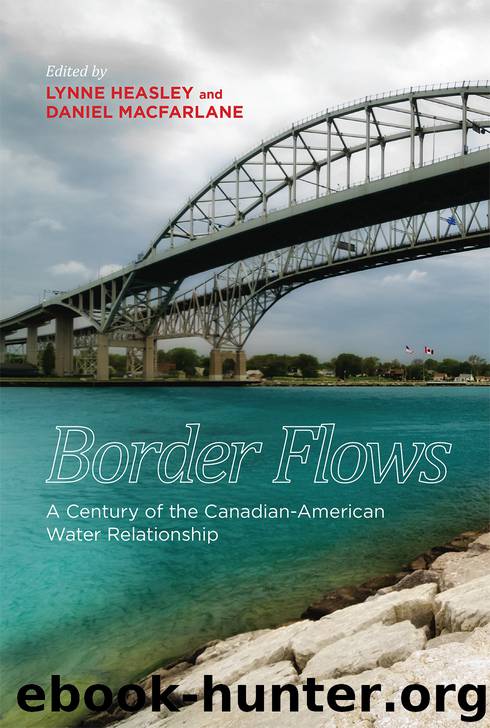
Border Flows by Lynne Heasley
Author:Lynne Heasley
Language: eng
Format: epub
Tags: Water, International relations,
Publisher: University of Calgary Press
Published: 2016-11-11T20:22:32+00:00
6
Engineering a Treaty: The Negotiation of the Columbia River Treaty of 1961/1964
Jeremy Mouat
The Columbia River Treaty first came to my attention in the mid-1990s.1 A regional power utility in British Columbia, West Kootenay Power, had commissioned me to write its centennial history. As I did the research for that book I came to appreciate the treaty’s significance. The creation of the Columbia Basin Trust in 1995, with its mandate to return some of the treaty’s financial benefits to that part of the province it had affected most, underlined the treaty’s continuing relevance in southeastern British Columbia. However, the orthodox view of the treaty—dominated by Neil Swainson’s Conflict over the Columbia2—seemed unsatisfactory because it appeared to give the treaty an inexorable logic. Swainson’s book failed to take seriously other possible outcomes or to do justice to the raucous debate that accompanied the treaty’s negotiation and signing. Contemporary accounts of the treaty in newspapers and journal articles contrasted sharply with Swainson’s reasoned prose. All of this piqued my interest, but I was working to a deadline and scrambled to finish the “treaty chapter.”
Some years later an American colleague encouraged me to give a paper on the treaty, and I began to reexamine the agreement more systematically. I was struck by the fact that the Columbia River had attracted a great deal of attention from American scholars, whose work offered much detail on the river’s history as well as suggesting its important role in the American imagination.3 This led me to question why Canadian scholars were less interested in the river than their American counterparts. I also came to appreciate that this greater American interest had had a very real impact on the Columbia’s history. Long before Canadians imagined harnessing the Columbia River’s hydroelectric potential, American engineers had devoted thousands of pages to that project—attention that led to a series of dams on the river. Canadian disinterest in the potential benefits of hydroelectricity, as Matthew Evenden has pointed out, reflected an unwillingness on the part of both governments and private industry to take decisive action: “Whereas large U.S. federal projects rose on the Columbia and Tennessee Rivers in the late 1930s with importance for American wartime production, in Canada public and private utilities sought to follow rather than promote demand.” This timidity would have important consequences when war came: “Canada’s major power systems were in a poor position to meet surges in wartime demand.”4
Such a perspective sees the Columbia River receiving the same neglect as other rivers in Canada. However, I want to argue that the Columbia River Treaty’s convoluted negotiation and the manner in which the treaty came to define the river made the Columbia unique, or, at least in some important respects, unlike many other rivers in Canada and shared transborder water basins. For example, Canadian interest in developing the Columbia River came long after American facilities had been planned and built along its length south of the border. This meant that any Canadian project would have to accommodate existing American installations on the Columbia.
Download
This site does not store any files on its server. We only index and link to content provided by other sites. Please contact the content providers to delete copyright contents if any and email us, we'll remove relevant links or contents immediately.
| Anthropology | Archaeology |
| Philosophy | Politics & Government |
| Social Sciences | Sociology |
| Women's Studies |
The Secret History by Donna Tartt(19103)
The Social Justice Warrior Handbook by Lisa De Pasquale(12197)
Thirteen Reasons Why by Jay Asher(8919)
This Is How You Lose Her by Junot Diaz(6894)
Weapons of Math Destruction by Cathy O'Neil(6284)
Zero to One by Peter Thiel(5808)
Beartown by Fredrik Backman(5767)
The Myth of the Strong Leader by Archie Brown(5513)
The Fire Next Time by James Baldwin(5454)
How Democracies Die by Steven Levitsky & Daniel Ziblatt(5225)
Promise Me, Dad by Joe Biden(5157)
Stone's Rules by Roger Stone(5091)
A Higher Loyalty: Truth, Lies, and Leadership by James Comey(4966)
100 Deadly Skills by Clint Emerson(4931)
Rise and Kill First by Ronen Bergman(4797)
Secrecy World by Jake Bernstein(4756)
The David Icke Guide to the Global Conspiracy (and how to end it) by David Icke(4723)
The Farm by Tom Rob Smith(4517)
The Doomsday Machine by Daniel Ellsberg(4493)
